What is the difference between digital printing and screen printing?
We are regularly asked what the difference is between digital printing and screen printing, but it cannot be explained in one sentence. In order to give a clear answer, we have explained these printing techniques in words and images below.
Digital printing
Digital printing is a neat name for printing. Other names for digital printing are Full Color or CMYK.
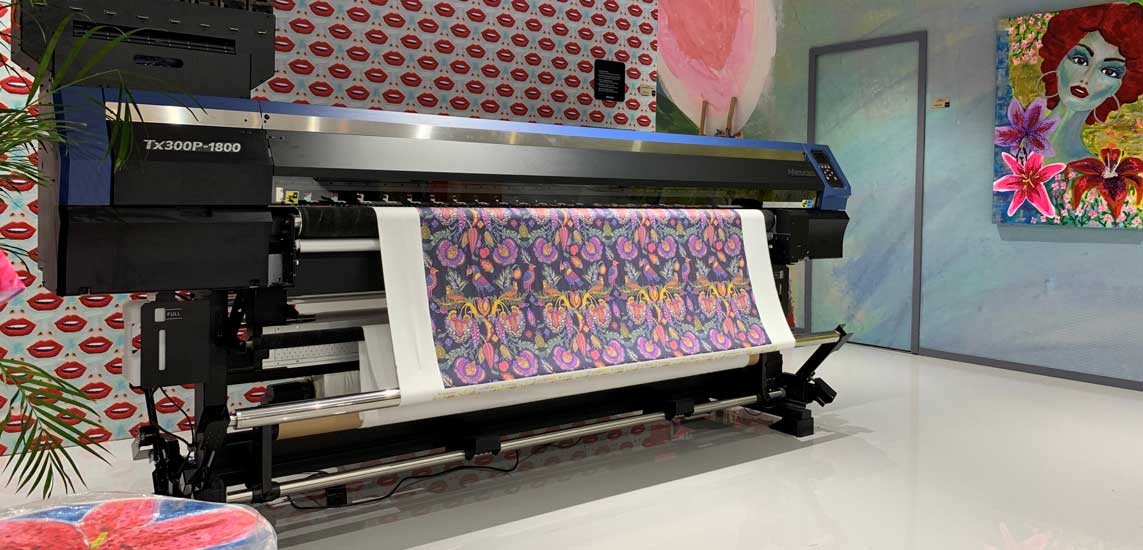
Many people are familiar with the operation of a normal desk printer with cartridges in the 4 main colors Cyan, Magenta, Yellow and Black (CMYK). Digital printing is actually a very large printer of over 300cm to 500cm wide through which a roll of fabric is fed and above which a print head prints the primary colors CMYK back and forth in strips on the fabric.
The big advantage of printing in Full Color is that every print can be different and there are no limitations in the number of colors. Even a color gradient, a shadow or photos can be printed. Each digital image can be sent directly to the printer and each color is built up by the printer from the 4 primary colors CMYK. That is why it is easy to have just 1 flag printed with any desired print and with a fast delivery time, because our printers are located in the Netherlands.
The disadvantage of printing in Full Color is that the colors in a logo are always composed of Cyan, Magenta, Yellow and Black and therefore a company color may differ slightly. There may also be a small shade difference between the front and back of the flag for some colors. It is also a disadvantage that printing in large quantities does not become much cheaper. The process of printing 1 flag or 100 flags remains the same.
You have probably already noticed that Black does not correspond to the K in CMYK, but the K means 'Key Color', it is the key color to make real black.
To make it even more complex, our flag printers have 6 colors CMYKVO. The V stands for Violet and the O for Orange. With these 2 extra colors, we have a larger color range possible and the blue tones and red tones in the color spectrum will give the best results.
Screen printing
The term screen printing already reveals that it is a printing technique that involves a screen.
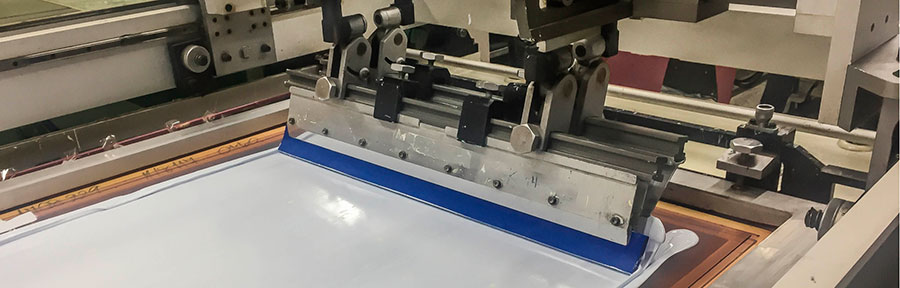
In this process, the ink is first mixed to the correct color and a screen frame is made containing a coated fine mesh with a recess in the coating for 1 color so that the ink can be pushed through at that location. The rest of the mesh is closed and does not allow ink to pass through. This screen frame is hung a few millimeters above the stretched fabric and with a squeegee or plastic strip the ink is pushed over the screen printing frame from left to right in one go. In places where the mesh is open, the ink will penetrate through the window into the fabric. The fabric is then fed to the 2nd screen frame where the next color with corresponding recess in the coating is ready.
Therefore, there is a clear difference in price whether the flag should be printed in 1, 2, 3 or 4 PMS colors. More than 4 PMS colors are rare, but it is possible, please request a quote. With many PMS colors you may also wonder whether it would not be more interesting to have the flags printed.
With screen printing, the colors are not printed on top of each other, but next to each other or against each other. The inks are mixed in advance to the correct color and therefore always printed with a full PMS color. A logo that contains a percentage of a color is considered a new color. Screen printing is ideal for logo flags andcompany banners. country flags or province flags are also often screen printed in large quantities.
Screen printed flags are printed in PMS colours. PMS stands for Pantone Matching System and is a global color standard of the Pantone brand. If we receive a PMS color number, it will be printed the same everywhere in the world. Bearing in mind that the surface on which printing is done may differ in gloss or structure.
'The color of a brand is crucial to its identity. Studies show that the right color can increase brand recognition by up to 87%.' source: Pantone.com
The advantage of screen printing is that colors are printed exactly according to color number and that the ink is completely absorbed into the fabric so that there is no difference in shade between the front and the back of the flag.
What is perhaps an even more important advantage is that this process becomes very economical for larger print runs. Due to the high start-up costs and shipping costs from Asia or Italy, this technique is quite expensive for small quantities, but for larger quantities the fixed costs are spread over the total amount and the unit price drops considerably. From 20 to 30 pieces, the price will be cheaper for screen printing than for digital printing, depending on the size and the number of PMS colors. The higher the number, the cheaper the screen printed flags are per piece.
The disadvantage of screen printing is that color gradients, shadows or photos cannot be printed. Even details that are too small can become clogged.
Because these screen printed flags are made in Asia or Italy. are produced, the delivery time is approximately 2 to 3 weeks. This is already quite smooth, but we cannot speed up this process for urgent orders.